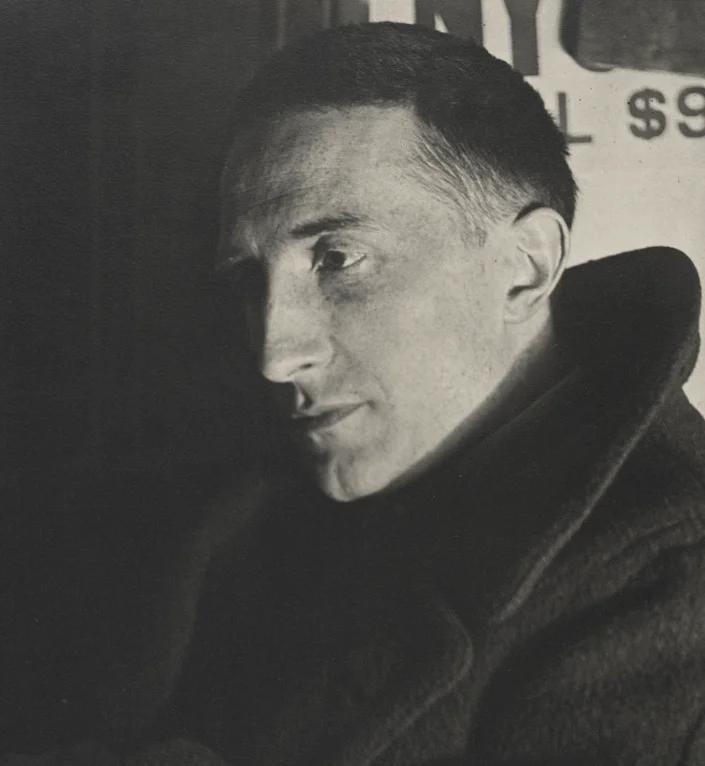
© Wikipedia Man Ray, 1920-21, Portrait of Marcel Duchamp, gelatin silver print, Yale University Art Gallery
Marcel Duchamp
American, French
1887 - 1968
"I don't believe in art. I believe in artists."
Did you know?
His most influential work, Fountain (1917), an ordinary urinal signed “R. Mutt,” was rejected and ridiculed when first submitted to an exhibition—yet today it is considered one of the most important artworks of the 20th century. Ironically, the original object was lost, and later authorized replicas are the ones displayed in major museums; despite this, these replicas are valued in the millions, proving that in Duchamp’s case the idea, not the object, became the true artwork.
Biography
Henri-Robert-Marcel Duchamp was a French American artist, chess player, and inventor who played a key role in the development of the avant-garde in the United States and in New York City, where he spent the last 25 years of his life.
Duchamp was the first artist to elevate a toilet to the status of an art form. By the time of World War I, he had rejected the work of many of his fellow artists (such as Henri Matisse) as "retinal," intended only to please the eye. Instead, he wanted to use art to serve the mind.
He is commonly regarded, along with Pablo Picasso and Georges Braque, as one of the three artists who helped to establish the post-industrial perspective in art history, and his work is considered the progenitor of Conceptual art.
Here are top reasons why Marcel Duchamp is one of the most important artists of the 20th century:
- He redefined what art can be- With his readymades—especially Fountain—Duchamp shifted art from craftsmanship to concept, arguing that an idea alone could make something art. Duchamp didn’t just make artworks—he permanently changed the rules of art itself. He introduced irony and play into modern art - Humor, wordplay, and intellectual games became legitimate artistic tools.
- He placed the artist’s choice at the center of art - Duchamp showed that authorship and intention matter more than manual skill, laying the foundation for Conceptual Art. He liberated artists from stylistic obligation - Duchamp proved an artist could stop producing traditional artworks and still remain radically influential.
- He challenged institutions and taste - By provoking museums, juries, and critics, he exposed how power structures shape artistic value.
- He influenced nearly all postwar avant-gardes - His ideas directly shaped Dada, Surrealism, Fluxus, Minimalism, and contemporary conceptual practices.