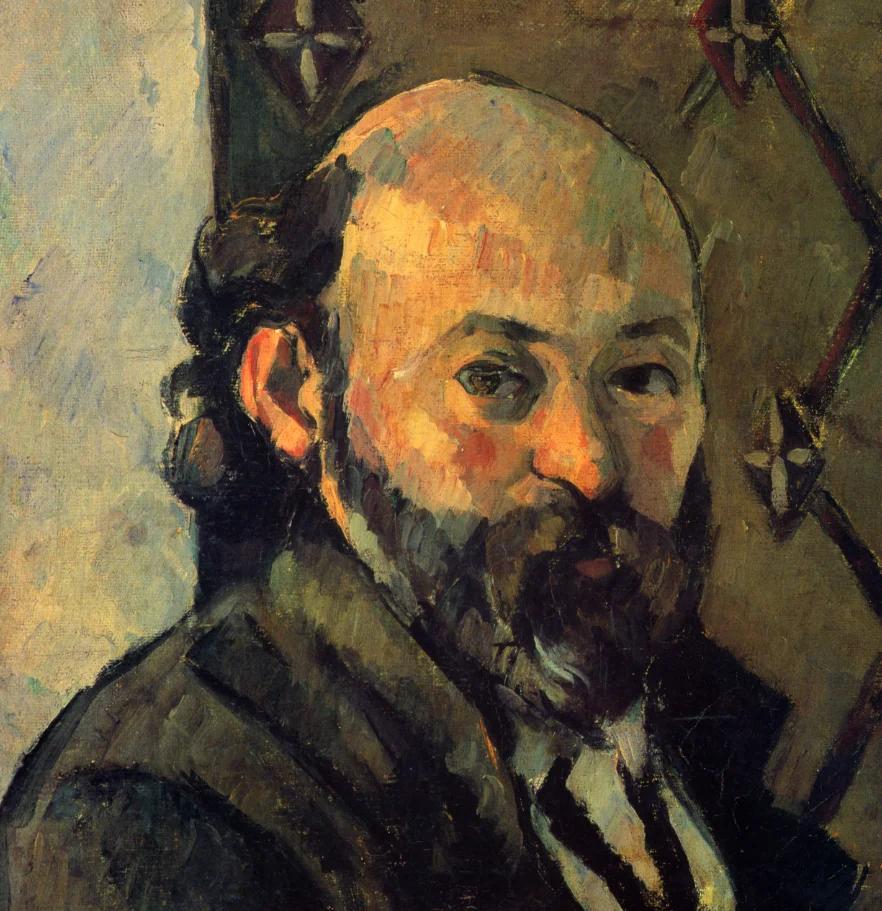
Self-portrait in front of olive wallpaper (detail) ©Public domain
Paul Cezanne
French
"We live in a rainbow of chaos."
Did you know?
A striking curiosity about Paul Cézanne’s art market is that one version of The Card Players was sold in a private sale around 2011 for an estimated $250 million, making it one of the most expensive paintings ever sold. The buyer was widely reported to be the royal family of Qatar, who were building one of the world’s most ambitious national art collections.
Biography
Paul Cézanne is widely regarded as one of the most influential figures in the transition from 19th-century Impressionism to 20th-century modern art.
He was a French Post-Impressionist painter whose work introduced new modes of representation, influenced avant-garde artistic movements of the early 20th century and formed the bridge between late 19th-century Impressionism and early 20th-century Cubism.
Although he exhibited with the Impressionists, Cézanne sought something more lasting than fleeting light effects, famously aiming to “make of Impressionism something solid and durable like the art of the museums.”
His work focused on structure, form, and geometry, reducing nature to cylinders, spheres, and cones, which radically changed how artists understood pictorial space.
Cézanne’s innovative use of broken brushstrokes and shifting perspectives challenged traditional linear perspective and gave paintings a sense of internal tension and balance.
He played a crucial role in redefining still life, landscape, and portrait painting, turning everyday subjects into profound studies of form and perception.
His repeated studies of Mont Sainte-Victoire became a laboratory for exploring how color and form construct space.
Artists such as Pablo Picasso and Georges Braque openly acknowledged Cézanne as a foundational influence on the development of Cubism.
Beyond Cubism, his impact extends to Fauvism, Abstract art, and much of modern painting.
Initially misunderstood and criticized, Cézanne gained recognition late in life, especially after a major retrospective in 1907.
Today, he is considered the “father of modern art,” whose work permanently transformed the way artists see and represent the world.