CC0 Public Domain Designation
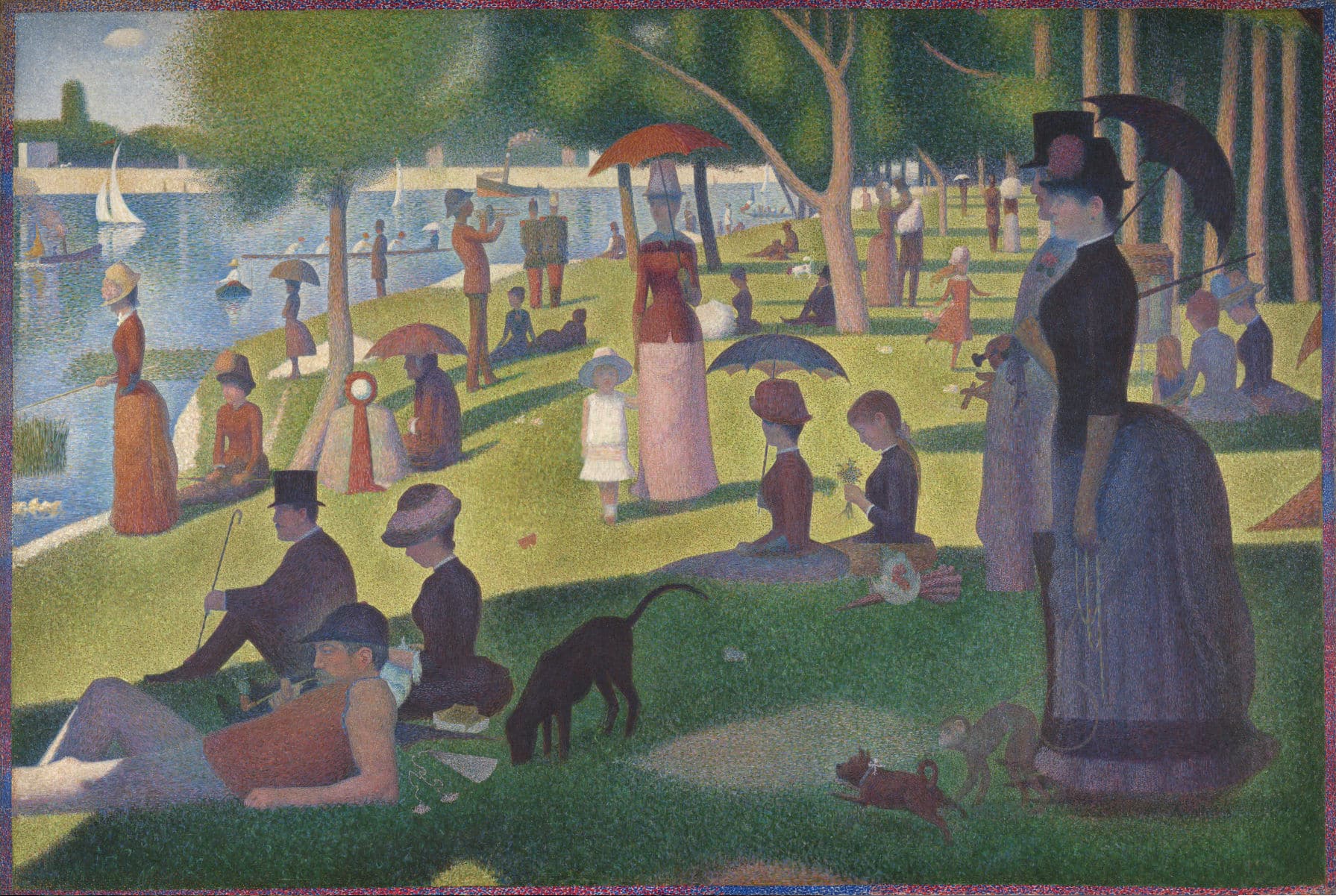
A Sunday Afternoon on the Island of La Grande Jatte
Georges Seurat, 1884
This painting is a prime example of pointillism, a technique he developed. This method involves applying small, distinct dots of color that, from a distance, blend together to form an image. This innovative approach to color and form had a significant influence on the direction of modern art.
Seurat applied principles of color theory and optical science to his work. By placing dots of complementary colors next to each other, he achieved greater luminosity and vibrancy than traditional methods allowed. This scientific approach to painting marked a departure from the more emotive and spontaneous techniques of the Impressionists. Measuring approximately 2 by 3 meters, the scale of the painting is impressive, and this was crucial in demonstrating the potential of pointillism as a serious artistic technique.
The composition of the painting is meticulously planned and executed and it captures a typical leisure activity of Parisians in the late 19th century giving us a snapshot of contemporary social customs and the interaction between different classes in a public space, reflecting the societal changes of the time.
Since its debut, “A Sunday Afternoon on the Island of La Grande Jatte” has been celebrated as a masterpiece of modern art. It has been referenced in various cultural contexts, from literature to film, and continues to be a major draw for visitors at the Art Institute of Chicago, where it is housed.