Wikimedia Commons
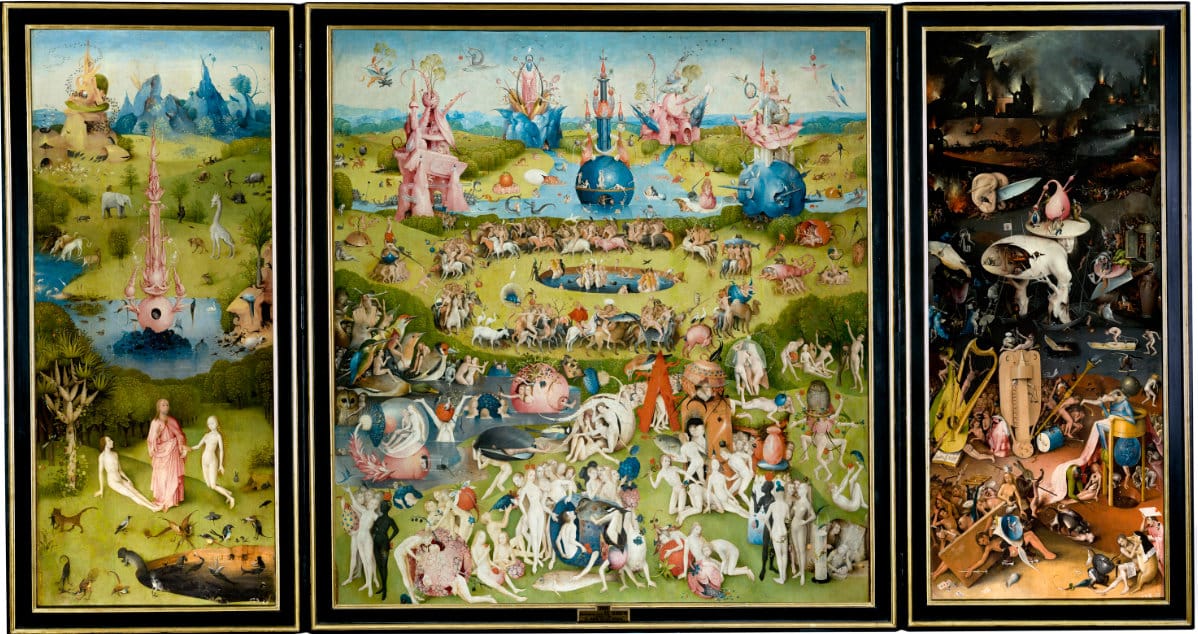
The Garden of Earthly Delights
Hieronymus Bosch, 1490
This work is truly astonishing; you can spend hours in front of it and always discover something new. Few works of art better encapsulate the wild ecstasy and strangeness of lust than Hieronymus Bosch’s famous triptych, The Garden of Earthly Delights.
The dominant theme of the painting is carnal pleasure, representing unbridled and deeply imaginative play. However, Bosch’s overall message is more complex, driven by intricate and cunning symbolism. Themes of sin, punishment, and hell permeate the masterpiece.
The triptych consists of three panels that address the fate of humanity: the Paradise of Adam and Eve on the left, a deceptive paradise in the center, and Hell on the right, all united by the theme of sin. When the painting is closed, a grisaille exterior alludes to the third day of creation.
The story of The Garden of Earthly Delights begins with its enigmatic creator, Hieronymus Bosch, born into a family of artists in what is now the Netherlands. It is believed that the “tree-man” looking directly at the viewer is a self-portrait of Bosch, but this remains another unresolved mystery.
Today, numerous scholars interpret the world Bosch creates in The Garden of Earthly Delights as a deceptive paradise that ultimately leads to punishment. The final panel illustrates a dim, humorously bizarre depiction of Hell. The link between the realms of pleasure and Hell, unified by the concept of sin, is highlighted by a continuous horizon line that runs through all three panels.
Bosch’s message was probably meant as a warning, yet the piece was also designed to be entertaining. The strength of Bosch’s work is found not only in its inventive, thought-provoking symbolism but also in its capacity to capture timeless human desires and present them to contemporary audiences with captivating relevance..
Considered an exception in the painting of its time and one of the most fascinating, mysterious, and captivating works in art history, Bosch’s style was an immediate success. It was copied by contemporaries such as Pieter Bruegel and later influenced the Surrealist movement, including Salvador Dalí and Joan Miró.