© 2024 Salvador Dalí, Gala-Salvador Dalí Foundation / Artists Rights Society (ARS), New York
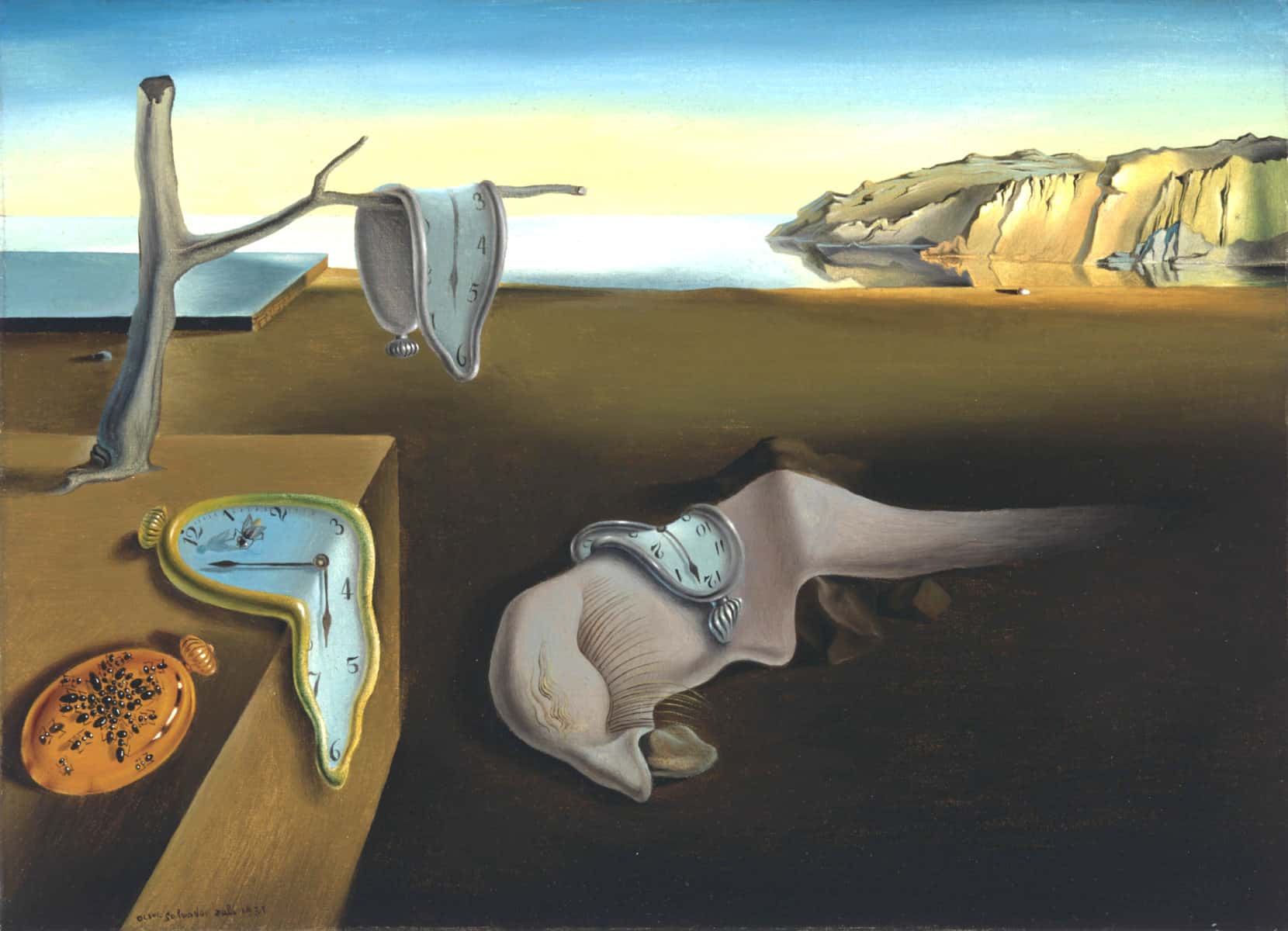
The Persistence of Memory
Salvador Dali, 1931
Sometimes known as “Melting Clocks,” “The Soft Watches,” and “The Melting Watches” this artwork is a surrealist masterpiece, one of the most recognizable pieces in the Surrealist movement.
Dalí’s ability to render dream-like, irrational scenes with precise, realistic detail epitomizes the Surrealist goal of exploring the unconscious mind and dreams. These soft, pliable timepieces challenge conventional perceptions of time, suggesting its fluid and subjective nature. This imagery has transcended art, becoming a cultural reference point for the concept of distorted or flexible time.
The painting depicts a dreamworld in which common objects are deformed and displayed in a bizarre and irrational way: watches, solid and hard objects, appear to be inexplicably limp and melting in the desolate landscape. Dalí paints his fantastical vision in a meticulous and realistic manner. And it appears that Dalí includes himself in the painting as a bizarre, fleshy creature located in the center. He stated that this self-portrait was inspired by a rock formation at Cap de Creus in northeast Catalonia. Additionally, some scholars have noted a resemblance between this self-portrait and a section of Hieronymus Bosch’s “The Garden of Earthly Delights.”
Since its creation, “The Persistence of Memory” has influenced not only art but also literature, film, and popular culture. Its distinctive visual elements have been referenced and parodied in various media, cementing its place in the collective cultural consciousness. The artwork is important not only for its artistic innovation and technical excellence but also for its profound psychological and cultural significance. It remains a powerful exploration of time, memory, and the human experience, resonating with audiences across generations.